English Tourism Week 2026 in Banbury: Ride a What to Where?

Day 2 of my English Tourism Week 2026 in Banbury – and let’s start off today with a question.

If you asked to guess what Banbury is most famous for – and you weren’t allowed to say “being near Bicester Village” – what might you say?

Well, if you read yesterday’s post you might say Banbury cakes. But let’s pretend you didn’t read it and you suggest ….?

Yes! The nursery rhyme.  You know the one:

Ride a cock horse to Banbury Cross
To see a fine lady upon a white horse
With rings on her fingers and bells on her toes
She shall have music wherever she goes.
For many people, that rhyme is their very first (and only) introduction to Banbury. And they are often delighted to learn that there really is a Banbury Cross.

The one we see today in the town centre isn’t one of the original medieval crosses. There were three – the White Cross, the Bread Cross, and the main Market Cross. Those were removed by the Puritans around 1600-1602. I mean, what do you expect from people who would frown on pastry.

Anyway, you can see the marker where the original Market Cross stood in the marketplace near the entrance to Castle Quay.

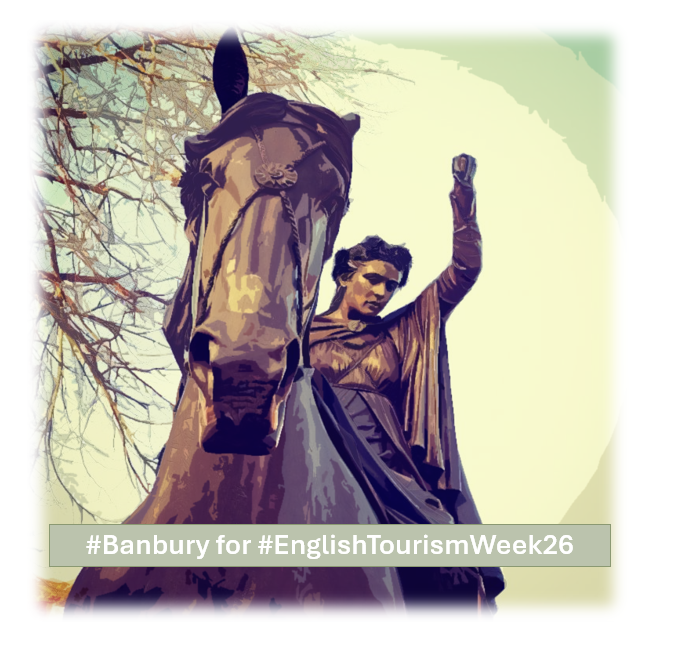
The current Banbury Cross, the one in the roundabout at the end of the High Street, was built in 1859 to celebrate the marriage of Queen Victoria’s daughter, Victoria, to Prince Frederick of Prussia. And it has its own fine lady, in the form of a statue across the way.

The statue is a much more recent addition, installed in 2005 and now one of the most photographed sights in town. Quite rightly too – it’s a striking statue and, thanks to its placement, full of excellent photographic angles and backgrounds.

But here’s another question and one that has been debated for generations:

Who exactly is the Fine Lady?

There are several theories.

  • Some believe she represents Queen Elizabeth I, who is known to have visited Banbury in the 1500s. Not sure I buy that.
  • Others suggest she might be Celia Fiennes. Sure there’s a vague local link but still not convinced.
  • And some historians think the rhyme may never have referred to a specific person at all. Probably the most likely.

Whatever the answer, the rhyme, the cross, and the Fine Lady have become part of Banbury’s identity.

So if you’re in town this week for English Tourism Week, take a moment to stop by Banbury Cross.

You’ll find the Fine Lady still riding proudly through the centre of town – rings on her fingers, bells on her toes, and a nursery rhyme that has been carrying Banbury’s name across the world for a very long time.

#Banbury #EnglishTourismWeek2026
English Tourism Week 2026 in Banbury: A Cake That Travelled the World

What better way to begin English Tourism Week in Banbury than with something Banbury has been famous for for centuries: the Banbury Cake.

At first glance, it is just a pastry – an oval parcel of flaky pastry filled with currants and spice. But Banbury cakes have a surprisingly long-standing story.

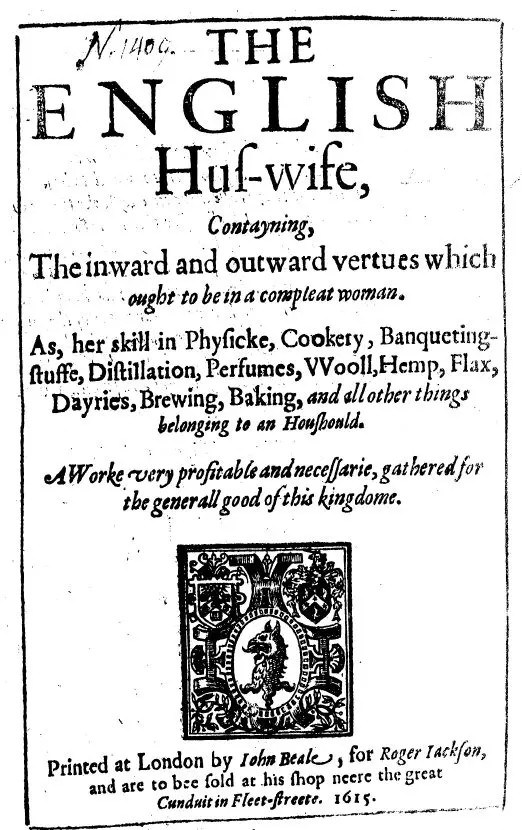
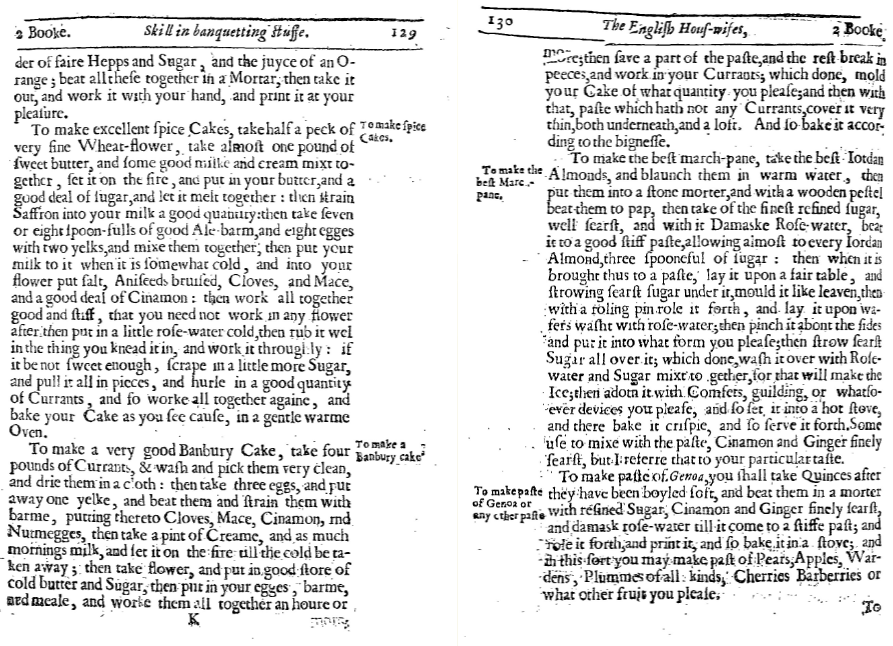
The oldest printed recipe for Banbury cakes was published by Gervase Markham in his book The English Huswife, first published in 1615. (Pictures below) It was quite a popular title in its day (a bestseller of its time, going through nine editions and at least two other reprints by 1683). Whether that was down to the popularity of the Banbury cake recipe, we cannot say.

Now, Banbury was known to be a stronghold of strict Puritans so it was only a matter of time before the Puritan authorities frowned officially on Banbury cakes (along with many festive foods associated with saints’ days). Despite that, the cakes endured. I suppose giving them an air of the forbidden just made them even more popular. Happens all the time, doesn’t it?

By the 18th and 19th centuries, they’d become one of Banbury’s best-known exports. Those passing through the town carried them away, and they were shipped far and wide – Australia, the East Indies and America just to name a few. What made them so good for long haul shipping? Their high sugar and spice content.

There is even a long-standing story that Queen Victoria enjoyed Banbury cakes and was given a supply every summer.

They are sometimes mistaken for Eccles cake but Banbury cakes are flatter and more oval, with a filling that often carries a sharper hit of spice and lemon peel.

There were two shops in Banbury most closely associated with the cakes over the years – The Original Cake Shop, located at 12 Parsons Street and Betts’ Cake Shop at 85 High Street. Four hundred years later, Banbury Cakes are still part of the town’s identity – and a rather tasty piece of local history and – with my marketing hat on – impressive brand longevity.

Not bad for something that began as a small local pastry.

So, the question of the day is: Have you ever actually tried a Banbury Cake? What did you think?

Banbury Area Businesses Awash in Awards

It may not be the Oscars but there’s been a lot of awards won around town lately –

First the 2025/26 Good Food Award winners were announced on November 10, two of my favourites here in Banbury won many well-deserved kudos.

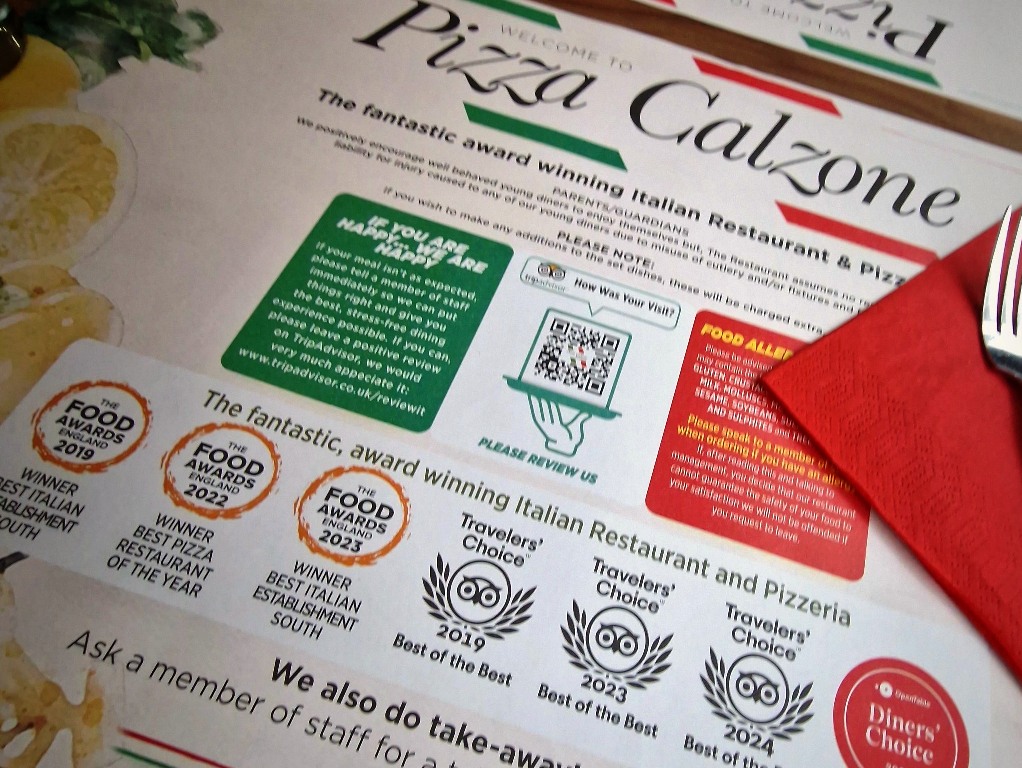
  • Pizza Calzone (Parsons St) was awarded a Blue Ribbon, not for the first time either.
  • And Reg’s Cafe (Thorpe Way) got the VERY IMPRESSIVE and highly-regarded Gold Seal. The Gold Seal goes to businesses that achieve consistently high customer ratings/votes over three years. This is the fourth or fifth year in a row that Reg’s has gotten a Good Food Award.

And then The 9th Annual Food Awards England came out and both Pizza Calzone and Reg’s won praise once more!

  • Pizza Calzone took two categories – Best Italian Establishment (South) and Outstanding Achievement in the Pizza of the Year category
  • Regs Café captured Café / Bistro of the Year (South)

And in the wider Banbury visitor landscape, Hook Norton Brewery was one of the winners at the VisitEngland Attractions Accolade Awards. They were awarded the VisitEngland Hidden Gem Accolade, which means it is being officially recognised as a top-tier visitor attraction.

These opinions not for sale

I got an absolutely hilarious comment over on the Banburian Facebook page. I was posting about why some people were gonna moan no matter what and pointed out once again that I’d rather highlight new stuff, share news from local businesses, find interesting stuff, and make constructive suggestions about changes (because nothing is perfect) than wallow in complaint about parking and hairdressers. . And the vast majority of people who follow that page and some all new people seemed very much on the same page. But then someone in the comments asked, ‘How much are you being paid to post that?’

And reader, I must tell you, I howled with laughter. As if! First of all, The Banburian – blog, Facebook and Instagram – are all 100% my own view, mostly my own pictures (sometimes Modern Parlance Photos pictures) and definitely completely unpaid. I mean, I wouldn’t take pay for this stuff – and second, who on earth do they think would pay for it?

Ridiculous. And I said so.

So, I just wanted to make sure we were on the same page as far as that goes. What you read here is my take and my take alone. No one has to agree with me – I would be amazed if everyone did – but no one, absolutely NO ONE is paying for favourable coverage or mentions.

Banbury as ‘Town of Culture’? Anything’s possible…

Earlier this month, news trickled out that there was to be a brand-new UK Town of Culture competition — a sort of sister effort to the more established City of Culture programme. And someone who writes about a UK town quite a lot, I got to thinking – what if Banbury were to put itself forward? What would that involve and — perhaps a bigger question — does Banbury have the cultural points to make a serious bid?

On the assumption that the City of Culture process would almost certainly form the blueprint for Town of Culture, I gave the documentation a read through and this list is the result.

5 points that credible submissions should include and how, IMO, Banbury stacks up.

1. A clear purpose and a long-term vision

Winning isn’t about throwing a year-long festival. It’s about culture as a driver of regeneration, community identity, pride and economic growth. Local participation, skills development, creative industries, tourism and long-term legacy all matter.

Banbury would need to show:

  • How culture boosts access and inclusion
  • How creativity fuels the local economy
  • How community cohesion is strengthened
  • How the benefits would last well beyond “the year of culture”

In short: it’s not about one big event. It’s about cultural transformation.

2. A compelling story — the “why Banbury, why now?”

Strong bids tell a story rooted in local identity, history, community character and connection to wider cultural networks. Banbury’s story is… layered, and frankly, pretty fascinating.

We have:

  • A multi-era heritage: Civil War, industrial history, canal culture, and literary connections
  • A famous identity thanks to a certain nursery rhyme
  • A town in transition, redefining itself in a modern context
  • Regional cultural links (Banbury Museum’s touring exhibitions are a great example)

A good submission weaves these strands together into something coherent and compelling.

3. The ability to deliver

A beautiful story won’t win on its own — applicants need a proven structure for delivering cultural programmes. The City of Culture criteria emphasise leadership, track record, cross-sector cooperation and sustainable planning. Banbury has excellent organisations and quite a few passionate stakeholders — but the collaborative structures would, again IMO, need real strengthening.

4. Measurable impact

There would need to be evaluation plans made to collect baseline data and to measure KPIs linked to expected outcomes. Much of which continues long after any win is announced. Winning isn’t the end; it’s the midpoint. The government wants to see a return on investment.

5. Inclusivity and access

A winning bid must involve everyone — not just established cultural players or the traditionally defined ‘great and the good.’ Grassroots groups, young people, diverse communities, neighbourhoods outside the town centre — all need a place in the plan. Fortunately, Banbury’s grassroots scene is strong: arts groups, choirs, music nights, heritage societies and community-led projects all contribute to a vibrant cultural fabric.


So… what does Banbury have going for it? A lot.

Heritage & History

  • Banbury Museum & Gallery
  • Tooley’s Boatyard
  • Banbury Cross, the Fine Lady statue
  • Ye Olde Reine Deer Inn
  • St Mary’s Church
  • The Oxford Canal

Arts & Culture

  • The Mill Arts Centre
  • Public art trails
  • A lively live-music scene
  • Local orchestras, choirs, amateur dramatics

Identity & Traditions

  • Banbury Cakes
  • The Hobby Horse tradition
  • The iconic nursery rhyme

Food & Family Culture

  • Lock29
  • The Light
  • Two major food festivals
  • A notably international restaurant scene — Turkish, Thai, Japanese, Polish, Italian, Indian and more

The Surrounding Cultural Ecosystem – more on this topic later but it is a significant part of a submission)

  • Broughton Castle
  • Upton House
  • Sulgrave Manor
  • Hook Norton Brewery
  • The Edgehill battlefield
  • British Motor Museum
  • Bicester Heritage

These assets tell a story of a town with depth, character and huge potential — not one that needs to invent a cultural identity, but one that already has one.

Could Banbury win?

It wouldn’t be easy. It would take collaboration and ambition. But the building blocks are absolutely there. Even the process of preparing a submission could spark new partnerships, projects and pride.

And honestly? It might just be worth it.