Banbury may be known for cakes, crosses and fine ladies on cock-horses but it’s worth noting that scattered about town you’ll find a range of public art. By public art, I mean either art paid for out of public funds or art which has come about via private means that happens to be in the public space. (All pictures below by Modern Parlance Photos)
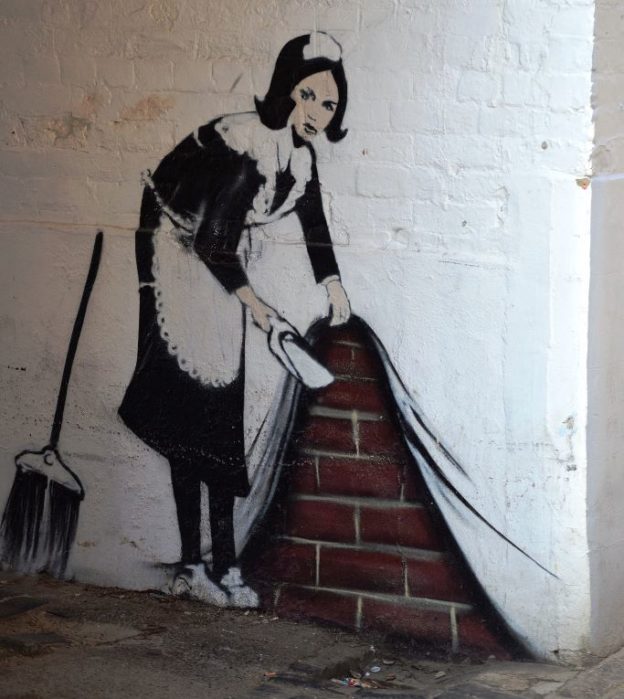
No, it’s not a Banksy but who cares? It’s entertaining and brightens up that little corner of the street.
The faux Banksy (above) sits on Butcher’s Row which also features an arch – spandrels, I am told they are called – where that streets meets the High Street. The “charms” hanging off the arch represent the various things traditionally found in the market (Banbury is a market town) back in days of yore. “Yore” wasn’t all that long ago in this instance – bell bottom jeans died first.
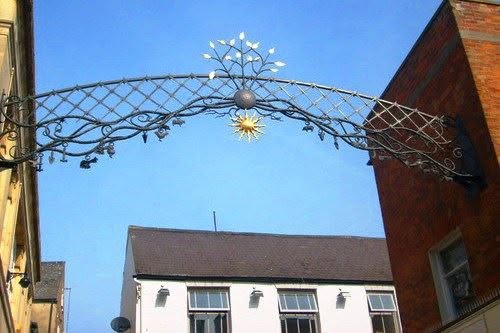 The sun, which anchors the piece and hangs prominently in the center – well, that shows up all over town and in all sorts of ways. It’s been a traditional heraldic symbol of Banbury since 1500s or so. You’ll also see the sun on the planters in and around the town centre. Those were designed by artist Pam Foley and were commissioned by Cherwell District Council in 2007.
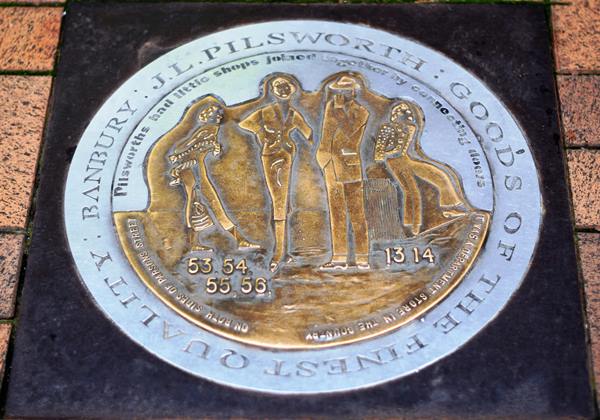
The other main pedestrian thoroughfare in Old Town is Parsons’ Street and here we have a series of inlays commissioned when the street was repaved and which tell the commercial history of the street. To be honest, until just recently I had never taken that close a look at the inlays but I found them so interesting, I’m gonna give them a post of their own. Soon.
JL Pilsworth was quite the department store in town – no fewer than six spaces on two sides of the street (adjacent spaces linked by connecting doors).
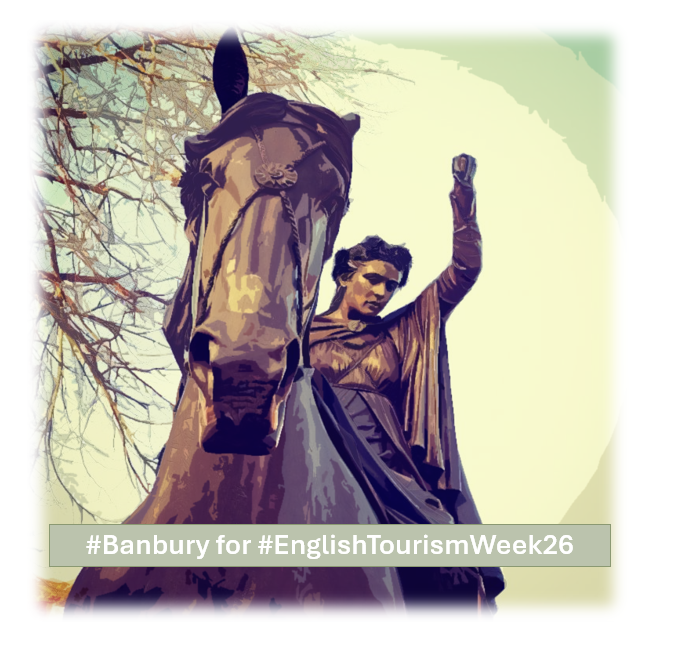
One of the most photographed spots in town is this one – just off the roundabout where North, South and West Bar meet. This is, of course, the statue of the Fine Lady of which I have written before and she is making her way to the Banbury Cross.
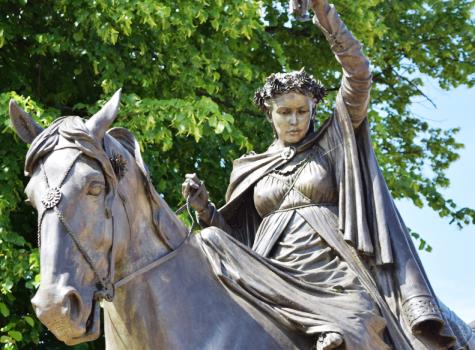
Fine Lady on her horse – facing the (not original but Victorian) Banbury Cross in the roundabout. I feel I really ought to put up a picture of the little frog as well (it’s under the horse’s raised hoof) but that can wait for another day. (Picture by Modern Parlance Photos)
If one cross is good, two were considered by some to be better. There is a large metal sculpture on Castle Street, sitting next to the Bolton Road Car Park (you can tell this picture isn’t the most recent as the multi-story is still in it – but never mind). Story goes that the artist either thought of it as a modern Banbury Cross, called it that or wanted it to become the modern Banbury Cross. There are a couple of stories on how it came to be – any or all of which may or may not be true. I am finding it difficult to find an actual paper trail on it.
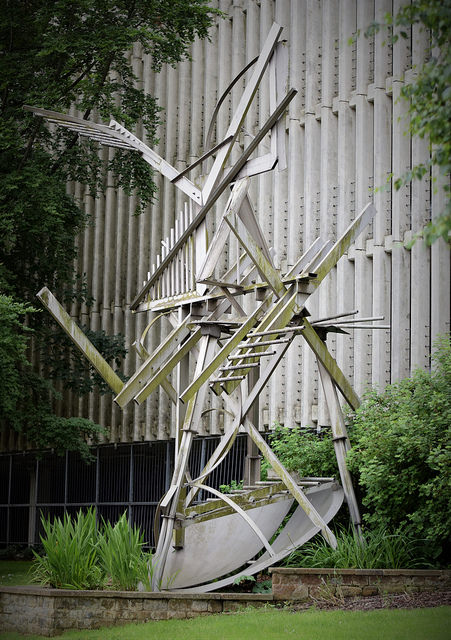
Maybe they “lost the paperwork” in the same way that the placement of the piece suggests someone was hoping it would get lost as well. If you don’t know it is there – and many don’t – and you aren’t looking, it fades right into the car park behind it. One wonders – or at least I wonder – what will happen to this installation. Will they move it? Toss it? Save it and reinstall it next to whatever is replacing the car park? Which ever they do – it is pretty obvious that maintaining it has never been high on anyone’s list. It looks a right mess, there’s no plaque explaining anything about it, no artist named and as far as I can tell, it has no official name of its own. I did see it called Castle Cross on some website but – again, who knows. In this picture, it actually looks not too bad. A tribute to the photographer.
In a slightly more central location – right along the canal and next to the Mill Arts Centre are a small group of markers which I am almost sure have something to do with the industrial days of the canal. I have looked at the inscriptions and it’s all about coal and canal horses but I have yet to transcribe them. The markers themselves look utterly different at different times of day. They’re a constantly changing piece depending on light and position.
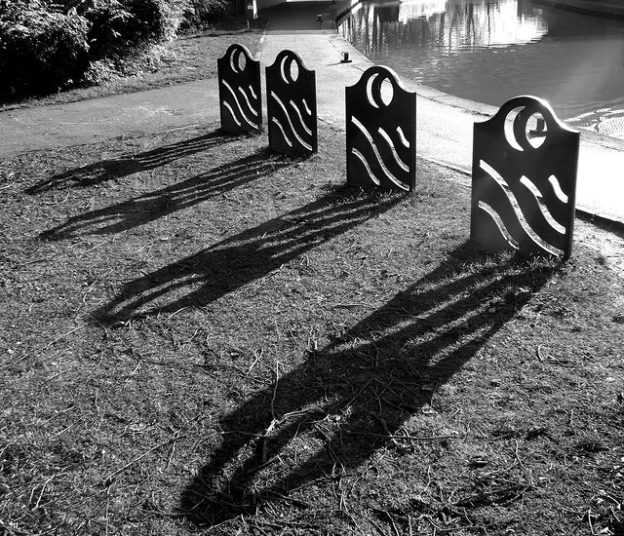
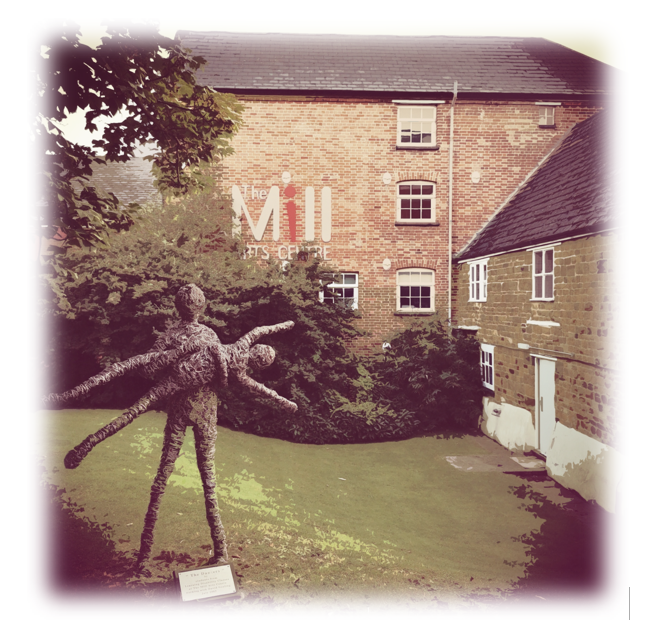
I love these markers at the Mill Arts Centre and I know nothing about them. I must rectify that. The Mill Arts Centre is also home to two wire sculptures – “The Dancers” and “Spaghetti-Legged Pete” – seen below (Picture by Modern Parlance Photos)
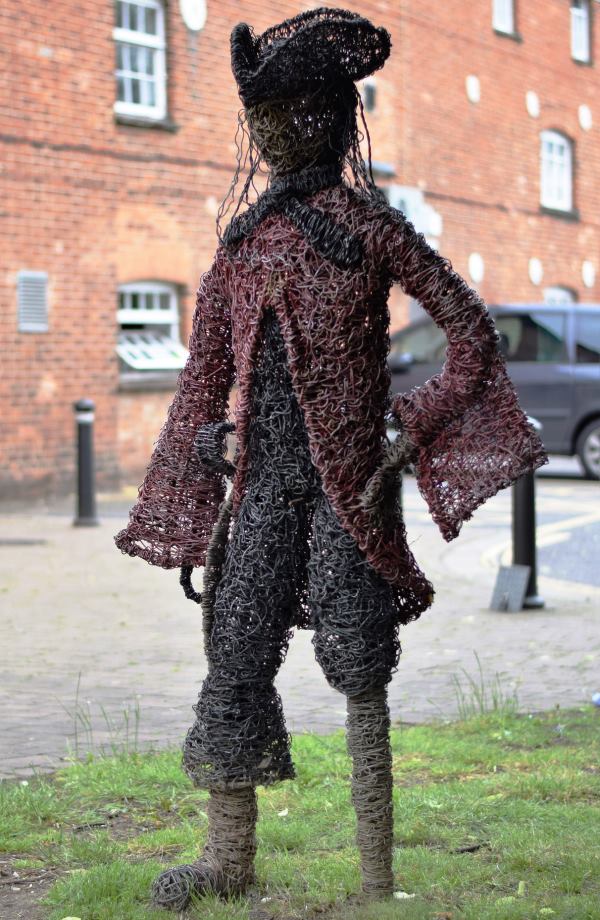
Next to the pedestrian bridge over the canal nearest the Mill Arts Centre is the first of the wire sculptures – which I call “sassy pirate” but which is allegedly called “Spaghetti-legged Pete” – something I was unable to confirm when this picture was taken since the plaque seems to be … missing.
The second wire sculpture – just past the pedestrian bridge in a small garden area of the Centre is “The Dancers” – now this plaque is very much in place and since the pieces are the same medium and style, I am guessing both were done by “students in the Learning Disability Classes working with David Gosling” at around the same time (2005).
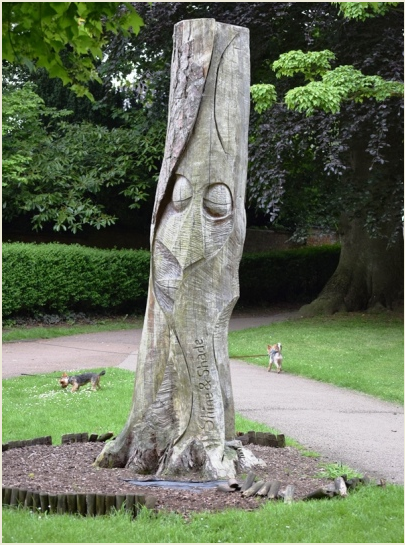
In another of the many green spots around town, there is a bit of – well, a sort of totem pole piece. This is “Shine & Shade” (thanks to Kitty for the correct info) and it is next to the Aviary in People’s Park.
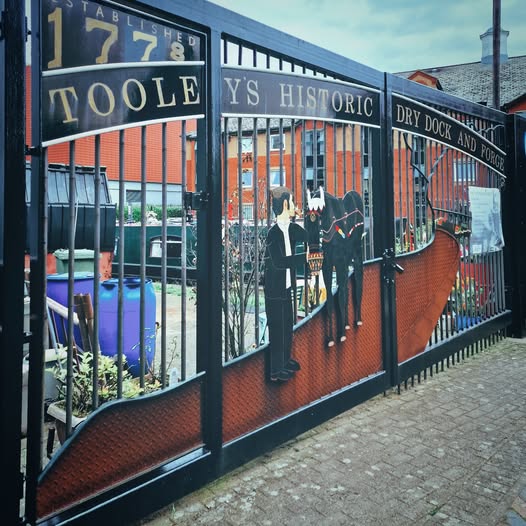
One of my favourite pieces of art about town is the gate at Tooley’s Boatyard. Not only is the gate itself fantastic, but the planting around it means it changes ever so slightly over time.
There are quite a few other examples of street art around town in a range of styles, there’s the floral horse outside Lock29, the Banbury Cross itself, and murals at Castle Quay (outside and inside in Lock29) and Bridge Street which have, in the past, triggered some …. robust public debate. And no, I am not wading into a debate about the Bridge Street mural. I didn’t get into it when it became the pigeon. I didn’t get into it when the pigeon went away and I am not getting into it now
The great thing about art – all of it – is that there is no right or wrong. Everyone brings something else to it – even when they are just looking at it, much less creating it. So everyone takes something different away from each piece. I love that about art.