It’s Day 4 of my English Tourism Week 2026 in Banbury series— and today we’ve gone literary.
When people think about literary tourism in Oxfordshire, their minds tend to jump straight to Oxford. Fair enough — it’s the literary elephant in the room.
But Banbury is not without literary connections of its own and, with literary tourism one of the fastest-growing travel trends around, they are worth knowing about.
We’ve already talked about one of Banbury’s best-known literary appearances — Ride a cock-horse to Banbury Cross. Scroll back to Post #2 of the series to find more detail on that. Today we’ve got an impressive array of other connections to get through.
Let’s start with the biggest literary name – Shakespeare.
At the top of the “The Merry Wives of Windsor’ that” Bardolf addresses Slender as “You Banbury Cheese!” and this would have been commonly understood by the playgoers as an insult implying there wasn’t much to him – Banbury cheese being only about an inch thick.
That’s not to say Banbury cheese wasn’t popular – it was. In fact, it was better known than Banbury cakes at the time. It was just thin.
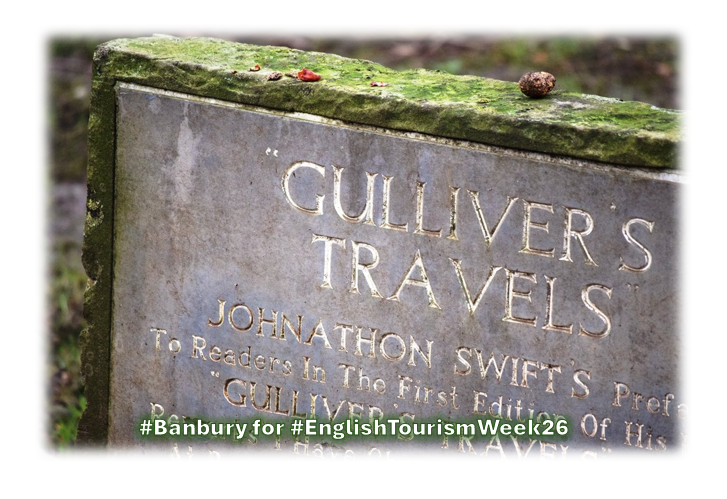
Banbury appears in one of the great works of English satire. As anyone who has seen the marker in the churchyard of St. Mary’s Church, Banbury knows, in the preface to the first edition of Gulliver’s Travels Jonathan Swift explains that he took the surname “Gulliver” from tombstones he saw in the churchyard of St Mary’s.
Move forward a few centuries and Banbury’s canal landscape makes another literary appearance — in quite a different literary world. The Oxford Canal that runs through town helped inspire the world of the “Gyptians” in Philip Pullman’s His Dark Materials trilogy. Pullman drew heavily on the culture of Britain’s canals — narrowboats, trading routes and the communities that lived and worked along them — many of which once passed directly through towns like Banbury.
Schools in the Banbury area also seem to have made an impression on authorial types.
Satirical novelist Tom Sharpe, best known for the Wilt series, was educated at nearby Bloxham School, which later appeared (thinly disguised) as Groxbourne in his novel Vintage Stuff.
Meanwhile Anthony Burgess, author of A Clockwork Orange, taught at Banbury Grammar School in the early 1950s and lived in nearby Adderbury, where he named his cottage “Little Gidding” after T. S. Eliot’s poem from Four Quartets.
Banbury also features in the history of publishing.
During the 18th and 19th centuries the town became a centre for chapbooks — small, inexpensive booklets often containing nursery rhymes, ballads and short tales for children. Local publisher John Golby Rusher distributed these widely across the country, helping Banbury earn a reputation as a surprising hub of popular literature. (The impact of the Rusher publishing empire was significant enough that I may well do a deeper dive on it for the Banburian blog.)
But significant as it was, it wasn’t the only notable publishing story to come from Banbury.
The canals themselves also inspired one of the most influential books ever written about Britain’s waterways.
Author L. T. C. (Tom) Rolt wrote Narrow Boat while living aboard the historic fly-boat Cressy, which had been adapted for him at Tooley’s Boatyard here in Banbury. His account of a 1939 journey through Britain’s then-declining canal system helped spark the movement that ultimately led to the restoration and preservation of the waterways many people enjoy today.
I’m not saying that any of this makes Banbury a rival to Oxford as a literary pilgrimage site any time soon. But it does show that the town has left its own interesting mark on everything from nursery rhymes to satire, canal writing to modern fantasy.
And that’s a local story worth telling.