Day 4 of English Tourism Week 2026 in Banbury is a Real Page Turner

It’s Day 4 of my English Tourism Week 2026 in Banbury series— and today we’ve gone literary.

When people think about literary tourism in Oxfordshire, their minds tend to jump straight to Oxford. Fair enough — it’s the literary elephant in the room.

But Banbury is not without literary connections of its own and, with literary tourism one of the fastest-growing travel trends around, they are worth knowing about.

We’ve already talked about one of Banbury’s best-known literary appearances — Ride a cock-horse to Banbury Cross. Scroll back to Post #2 of the series to find more detail on that. Today we’ve got an impressive array of other connections to get through.

Let’s start with the biggest literary name – Shakespeare.

At the top of the “The Merry Wives of Windsor’ that” Bardolf addresses Slender as “You Banbury Cheese!” and this would have been commonly understood by the playgoers as an insult implying there wasn’t much to him – Banbury cheese being only about an inch thick.

That’s not to say Banbury cheese wasn’t popular – it was. In fact, it was better known than Banbury cakes at the time. It was just thin.

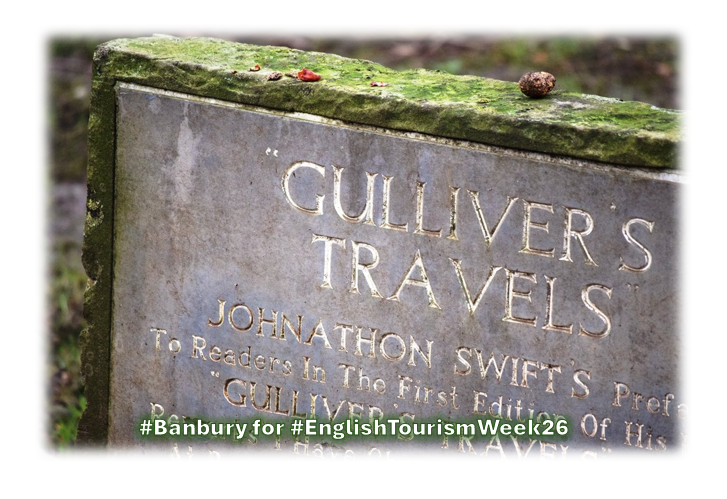
Banbury appears in one of the great works of English satire. As anyone who has seen the marker in the churchyard of St. Mary’s Church, Banbury knows, in the preface to the first edition of Gulliver’s Travels Jonathan Swift explains that he took the surname “Gulliver” from tombstones he saw in the churchyard of St Mary’s.

Move forward a few centuries and Banbury’s canal landscape makes another literary appearance — in quite a different literary world. The Oxford Canal that runs through town helped inspire the world of the “Gyptians” in Philip Pullman’s His Dark Materials trilogy. Pullman drew heavily on the culture of Britain’s canals — narrowboats, trading routes and the communities that lived and worked along them — many of which once passed directly through towns like Banbury.

Schools in the Banbury area also seem to have made an impression on authorial types.

Satirical novelist Tom Sharpe, best known for the Wilt series, was educated at nearby Bloxham School, which later appeared (thinly disguised) as Groxbourne in his novel Vintage Stuff.

Meanwhile Anthony Burgess, author of A Clockwork Orange, taught at Banbury Grammar School in the early 1950s and lived in nearby Adderbury, where he named his cottage “Little Gidding” after T. S. Eliot’s poem from Four Quartets.

Banbury also features in the history of publishing.

During the 18th and 19th centuries the town became a centre for chapbooks — small, inexpensive booklets often containing nursery rhymes, ballads and short tales for children. Local publisher John Golby Rusher distributed these widely across the country, helping Banbury earn a reputation as a surprising hub of popular literature. (The impact of the Rusher publishing empire was significant enough that I may well do a deeper dive on it for the Banburian blog.)

But significant as it was, it wasn’t the only notable publishing story to come from Banbury.

The canals themselves also inspired one of the most influential books ever written about Britain’s waterways.

Author L. T. C. (Tom) Rolt wrote Narrow Boat while living aboard the historic fly-boat Cressy, which had been adapted for him at Tooley’s Boatyard here in Banbury. His account of a 1939 journey through Britain’s then-declining canal system helped spark the movement that ultimately led to the restoration and preservation of the waterways many people enjoy today.

I’m not saying that any of this makes Banbury a rival to Oxford as a literary pilgrimage site any time soon. But it does show that the town has left its own interesting mark on everything from nursery rhymes to satire, canal writing to modern fantasy.

And that’s a local story worth telling.

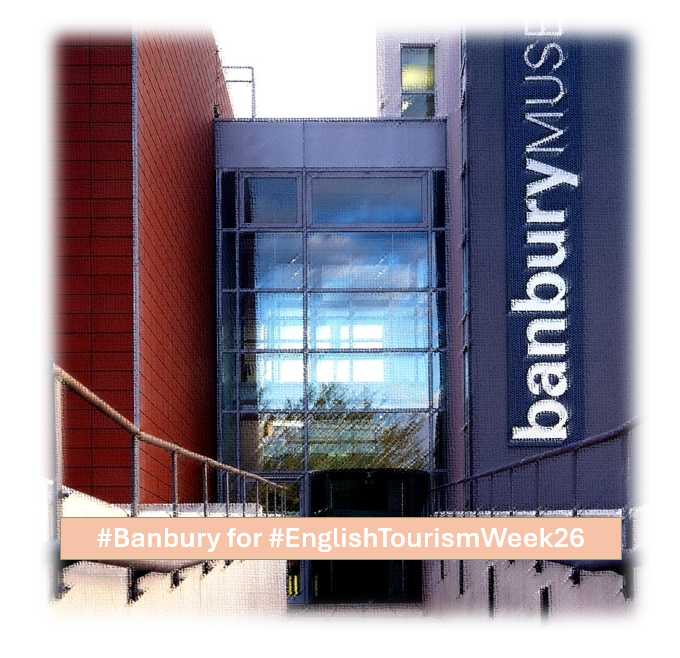
English Tourism Week 2026 in Banbury: Banbury Museum

3rd Day of English Tourism Week and so time for the next post in my English Tourism Week 2026 in Banbury series.

One of the things English Tourism Week is meant to highlight is how local stories and local places shape the wider visitor economy.

Which brings me to a place in Banbury that doesn’t always get the attention it deserves — Banbury Museum & Gallery.

If you’ve walked along the canal from Spiceball Park, along The Light Banbury, past the GF Club And Waterside Bar Banbury – you’ve almost certainly seen it. The glass-fronted building sits right alongside the Oxford Canal and holds the story of Banbury and the surrounding area within it.

The museum’s permanent collections cover everything from the town’s Civil War connections and famous Banbury cakes to Victorian industry, canal trade and the everyday lives of the people who lived here over the centuries. It’s the sort of place where you can wander in for a quick look and suddenly realise you’ve spent far longer than planned.

And then there is the Pye Gallery – a space that hosts an impressive array of temporary and traveling exhibitions covering everything from Grayson Perry to Vikings, from 90s pop culture to robots and Lego, and even Wildlife Photographer of the Year.

Like many local museums across the country, Banbury Museum recently found itself at the centre of a debate about funding and priorities. When the possibility of losing support was raised, local residents made it very clear how much the museum matters to the town – and I must say I was pleasantly surprised to see how many people came out in support of the museum as quickly as they did.

Letters were written. Voices were raised. A great deal of hullabaloo ensued. And I wasn’t the only one surprised. In the end, the message landed: this is a cultural asset that the people of Banbury value, and the council found the money after all.

The museum remains open, continuing to tell the stories of the town and the people who shaped it.

So if you’re exploring Banbury during English Tourism Week, it’s well worth stepping inside.

Because behind that glass façade is not just a collection of objects — it’s the story of Banbury itself.

#Banbury #englishtourismweek2026

English Tourism Week 2026 in Banbury: Ride a What to Where?

Day 2 of my English Tourism Week 2026 in Banbury – and let’s start off today with a question.

If you asked to guess what Banbury is most famous for – and you weren’t allowed to say “being near Bicester Village” – what might you say?

Well, if you read yesterday’s post you might say Banbury cakes. But let’s pretend you didn’t read it and you suggest ….?

Yes! The nursery rhyme.  You know the one:

Ride a cock horse to Banbury Cross
To see a fine lady upon a white horse
With rings on her fingers and bells on her toes
She shall have music wherever she goes.

For many people, that rhyme is their very first (and only) introduction to Banbury. And they are often delighted to learn that there really is a Banbury Cross.

The one we see today in the town centre isn’t one of the original medieval crosses. There were three – the White Cross, the Bread Cross, and the main Market Cross. Those were removed by the Puritans around 1600-1602. I mean, what do you expect from people who would frown on pastry.

Anyway, you can see the marker where the original Market Cross stood in the marketplace near the entrance to Castle Quay.

The current Banbury Cross, the one in the roundabout at the end of the High Street, was built in 1859 to celebrate the marriage of Queen Victoria’s daughter, Victoria, to Prince Frederick of Prussia. And it has its own fine lady, in the form of a statue across the way.

The statue is a much more recent addition, installed in 2005 and now one of the most photographed sights in town. Quite rightly too – it’s a striking statue and, thanks to its placement, full of excellent photographic angles and backgrounds.

But here’s another question and one that has been debated for generations:

Who exactly is the Fine Lady?

There are several theories.

  • Some believe she represents Queen Elizabeth I, who is known to have visited Banbury in the 1500s. Not sure I buy that.
  • Others suggest she might be Celia Fiennes. Sure there’s a vague local link but still not convinced.
  • And some historians think the rhyme may never have referred to a specific person at all. Probably the most likely.

Whatever the answer, the rhyme, the cross, and the Fine Lady have become part of Banbury’s identity.

So if you’re in town this week for English Tourism Week, take a moment to stop by Banbury Cross.

You’ll find the Fine Lady still riding proudly through the centre of town – rings on her fingers, bells on her toes, and a nursery rhyme that has been carrying Banbury’s name across the world for a very long time.

#Banbury #EnglishTourismWeek2026

English Tourism Week 2026 in Banbury: A Cake That Travelled the World

What better way to begin English Tourism Week in Banbury than with something Banbury has been famous for for centuries: the Banbury Cake.

At first glance, it is just a pastry – an oval parcel of flaky pastry filled with currants and spice. But Banbury cakes have a surprisingly long-standing story.

The oldest printed recipe for Banbury cakes was published by Gervase Markham in his book The English Huswife, first published in 1615. (Pictures below) It was quite a popular title in its day (a bestseller of its time, going through nine editions and at least two other reprints by 1683). Whether that was down to the popularity of the Banbury cake recipe, we cannot say.

Now, Banbury was known to be a stronghold of strict Puritans so it was only a matter of time before the Puritan authorities frowned officially on Banbury cakes (along with many festive foods associated with saints’ days). Despite that, the cakes endured. I suppose giving them an air of the forbidden just made them even more popular. Happens all the time, doesn’t it?

By the 18th and 19th centuries, they’d become one of Banbury’s best-known exports. Those passing through the town carried them away, and they were shipped far and wide – Australia, the East Indies and America just to name a few. What made them so good for long haul shipping? Their high sugar and spice content.

There is even a long-standing story that Queen Victoria enjoyed Banbury cakes and was given a supply every summer.

They are sometimes mistaken for Eccles cake but Banbury cakes are flatter and more oval, with a filling that often carries a sharper hit of spice and lemon peel.

There were two shops in Banbury most closely associated with the cakes over the years – The Original Cake Shop, located at 12 Parsons Street and Betts’ Cake Shop at 85 High Street. Four hundred years later, Banbury Cakes are still part of the town’s identity – and a rather tasty piece of local history and – with my marketing hat on – impressive brand longevity.

Not bad for something that began as a small local pastry.

So, the question of the day is: Have you ever actually tried a Banbury Cake? What did you think?

Banbury as ‘Town of Culture’? Anything’s possible…

Earlier this month, news trickled out that there was to be a brand-new UK Town of Culture competition — a sort of sister effort to the more established City of Culture programme. And someone who writes about a UK town quite a lot, I got to thinking – what if Banbury were to put itself forward? What would that involve and — perhaps a bigger question — does Banbury have the cultural points to make a serious bid?

On the assumption that the City of Culture process would almost certainly form the blueprint for Town of Culture, I gave the documentation a read through and this list is the result.

5 points that credible submissions should include and how, IMO, Banbury stacks up.

1. A clear purpose and a long-term vision

Winning isn’t about throwing a year-long festival. It’s about culture as a driver of regeneration, community identity, pride and economic growth. Local participation, skills development, creative industries, tourism and long-term legacy all matter.

Banbury would need to show:

  • How culture boosts access and inclusion
  • How creativity fuels the local economy
  • How community cohesion is strengthened
  • How the benefits would last well beyond “the year of culture”

In short: it’s not about one big event. It’s about cultural transformation.

2. A compelling story — the “why Banbury, why now?”

Strong bids tell a story rooted in local identity, history, community character and connection to wider cultural networks. Banbury’s story is… layered, and frankly, pretty fascinating.

We have:

  • A multi-era heritage: Civil War, industrial history, canal culture, and literary connections
  • A famous identity thanks to a certain nursery rhyme
  • A town in transition, redefining itself in a modern context
  • Regional cultural links (Banbury Museum’s touring exhibitions are a great example)

A good submission weaves these strands together into something coherent and compelling.

3. The ability to deliver

A beautiful story won’t win on its own — applicants need a proven structure for delivering cultural programmes. The City of Culture criteria emphasise leadership, track record, cross-sector cooperation and sustainable planning. Banbury has excellent organisations and quite a few passionate stakeholders — but the collaborative structures would, again IMO, need real strengthening.

4. Measurable impact

There would need to be evaluation plans made to collect baseline data and to measure KPIs linked to expected outcomes. Much of which continues long after any win is announced. Winning isn’t the end; it’s the midpoint. The government wants to see a return on investment.

5. Inclusivity and access

A winning bid must involve everyone — not just established cultural players or the traditionally defined ‘great and the good.’ Grassroots groups, young people, diverse communities, neighbourhoods outside the town centre — all need a place in the plan. Fortunately, Banbury’s grassroots scene is strong: arts groups, choirs, music nights, heritage societies and community-led projects all contribute to a vibrant cultural fabric.


So… what does Banbury have going for it? A lot.

Heritage & History

  • Banbury Museum & Gallery
  • Tooley’s Boatyard
  • Banbury Cross, the Fine Lady statue
  • Ye Olde Reine Deer Inn
  • St Mary’s Church
  • The Oxford Canal

Arts & Culture

  • The Mill Arts Centre
  • Public art trails
  • A lively live-music scene
  • Local orchestras, choirs, amateur dramatics

Identity & Traditions

  • Banbury Cakes
  • The Hobby Horse tradition
  • The iconic nursery rhyme

Food & Family Culture

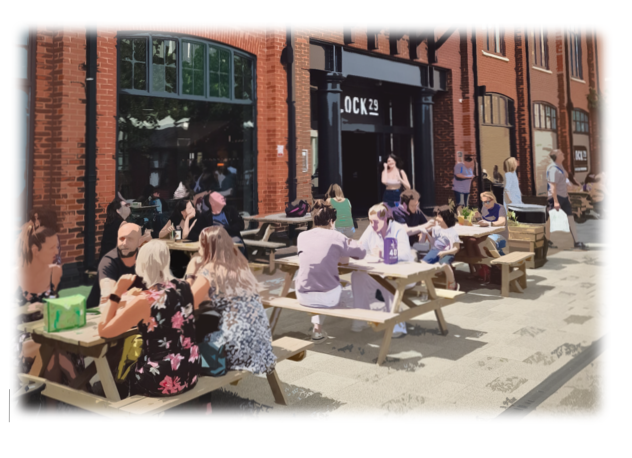
  • Lock29
  • The Light
  • Two major food festivals
  • A notably international restaurant scene — Turkish, Thai, Japanese, Polish, Italian, Indian and more

The Surrounding Cultural Ecosystem – more on this topic later but it is a significant part of a submission)

  • Broughton Castle
  • Upton House
  • Sulgrave Manor
  • Hook Norton Brewery
  • The Edgehill battlefield
  • British Motor Museum
  • Bicester Heritage

These assets tell a story of a town with depth, character and huge potential — not one that needs to invent a cultural identity, but one that already has one.

Could Banbury win?

It wouldn’t be easy. It would take collaboration and ambition. But the building blocks are absolutely there. Even the process of preparing a submission could spark new partnerships, projects and pride.

And honestly? It might just be worth it.