Day 6 of English Tourism Week in Banbury Heads Out to the Park

And we’re back on the #Banbury for #EnglishTourismWeek26 train with more insight into what makes Banbury such a great domestic tourism destination. Today – Spiceball Park. The glorious green space with the slightly weird name.

This post was inspired by yesterday’s glorious weather, weather that promises to continue today. I can’t say beyond that, but spring will bed in eventually. Right?

Let’s start with a few Spiceball stats and highlights:

  • At 26 acres, it is the largest park in the town.
  • It is a combination of ‘tended’ and ‘wild’ areas.
  • This is actually the second Spiceball Park (more on that later).
  • Setting for lots of town events (posted on those the other day)
  • Is home to the weekly Banbury parkrun
  • There’s a picnic area with free, DIY barbecue set-ups.
  • Features include a children’s play area, skate ramps, and a circuit of footpaths, some dotted with fitness equipment.

But before I tell you why Spiceball is one of the places to be as the weather improves, we have to address the “meatball” in the room. I mean – Spiceball? What kind of name is that?

I’ve touched on this before, but it amuses me so much, I can’t help sharing it again. I’m aware stuff like this often takes the form of slightly questionable local lore, but I found this on the Banbury Town Council website, so I have no reason to doubt it.

In 1894, the then town mayor, a butcher named Thomas Hankinson, donated a plot of land so that the ‘poor people of Banbury’ could have a recreation area. Hankinson, as it happens, was known for his handmade meatballs, known throughout town as ‘spiceballs’ (though I have no idea what the spice in question was).

The original gifted land was what we now know as Bridge Street Park. When the larger space was created in the current location, the name came along with it, and the old site got a new name.

Connect to Nature… and to Banbury’s activity hotspots

Spiceball Park is a ‘green link’ from the centre of Banbury to Grimsbury Reservoir and the Oxford Canal towpath.

  • Paths at the southern end of the park lead you to The Light Banbury, The Mill Arts Centre, lock29.banbury, Castle Quay, and the Banbury Museum & Gallery – all just a few minutes’ walk away.
  • To the north, the park’s trails extend toward Grimsbury Reservoir and the Grimsbury Woodland Reserve (managed by the Banbury Ornithological Society). The reservoir probably deserves its own post, but for now, just know that it is surrounded by a flat, circular footpath (excellent for walking, jogging and dog walking), and is home to the Banbury Cross Sailing Club.

Generic visitor pamphlets might tell you the park is “lovely” – and it is. But it wouldn’t mention that Spiceball Park can be the core of a great day out, or even a relaxing weekend away.

It’s a great place to embrace nature, get some steps in, or have a run around with the dog or the kids – or both. When you’re ready to move indoors, you can wander from the park’s trails directly into the buzz of The Light Banbury for a film, head to The Mill for an evening of comedy, or visit Lock29 for a bit of independent shopping or lunch.

So, while the spiced meatballs are no more, we still have the park and all it offers. Get out there while the weather holds.
Day 4 of English Tourism Week 2026 in Banbury is a Real Page Turner

It’s Day 4 of my English Tourism Week 2026 in Banbury series— and today we’ve gone literary.

When people think about literary tourism in Oxfordshire, their minds tend to jump straight to Oxford. Fair enough — it’s the literary elephant in the room.

But Banbury is not without literary connections of its own and, with literary tourism one of the fastest-growing travel trends around, they are worth knowing about.

We’ve already talked about one of Banbury’s best-known literary appearances — Ride a cock-horse to Banbury Cross. Scroll back to Post #2 of the series to find more detail on that. Today we’ve got an impressive array of other connections to get through.

Let’s start with the biggest literary name – Shakespeare.

At the top of the “The Merry Wives of Windsor’ that” Bardolf addresses Slender as “You Banbury Cheese!” and this would have been commonly understood by the playgoers as an insult implying there wasn’t much to him – Banbury cheese being only about an inch thick.

That’s not to say Banbury cheese wasn’t popular – it was. In fact, it was better known than Banbury cakes at the time. It was just thin.

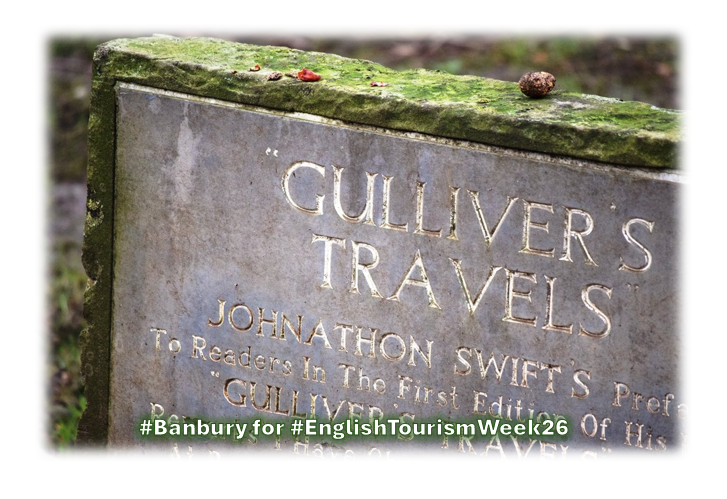
Banbury appears in one of the great works of English satire. As anyone who has seen the marker in the churchyard of St. Mary’s Church, Banbury knows, in the preface to the first edition of Gulliver’s Travels Jonathan Swift explains that he took the surname “Gulliver” from tombstones he saw in the churchyard of St Mary’s.

Move forward a few centuries and Banbury’s canal landscape makes another literary appearance — in quite a different literary world. The Oxford Canal that runs through town helped inspire the world of the “Gyptians” in Philip Pullman’s His Dark Materials trilogy. Pullman drew heavily on the culture of Britain’s canals — narrowboats, trading routes and the communities that lived and worked along them — many of which once passed directly through towns like Banbury.

Schools in the Banbury area also seem to have made an impression on authorial types.

Satirical novelist Tom Sharpe, best known for the Wilt series, was educated at nearby Bloxham School, which later appeared (thinly disguised) as Groxbourne in his novel Vintage Stuff.

Meanwhile Anthony Burgess, author of A Clockwork Orange, taught at Banbury Grammar School in the early 1950s and lived in nearby Adderbury, where he named his cottage “Little Gidding” after T. S. Eliot’s poem from Four Quartets.

Banbury also features in the history of publishing.

During the 18th and 19th centuries the town became a centre for chapbooks — small, inexpensive booklets often containing nursery rhymes, ballads and short tales for children. Local publisher John Golby Rusher distributed these widely across the country, helping Banbury earn a reputation as a surprising hub of popular literature. (The impact of the Rusher publishing empire was significant enough that I may well do a deeper dive on it for the Banburian blog.)

But significant as it was, it wasn’t the only notable publishing story to come from Banbury.

The canals themselves also inspired one of the most influential books ever written about Britain’s waterways.

Author L. T. C. (Tom) Rolt wrote Narrow Boat while living aboard the historic fly-boat Cressy, which had been adapted for him at Tooley’s Boatyard here in Banbury. His account of a 1939 journey through Britain’s then-declining canal system helped spark the movement that ultimately led to the restoration and preservation of the waterways many people enjoy today.

I’m not saying that any of this makes Banbury a rival to Oxford as a literary pilgrimage site any time soon. But it does show that the town has left its own interesting mark on everything from nursery rhymes to satire, canal writing to modern fantasy.

And that’s a local story worth telling.

English Tourism Week 2026 in Banbury: Banbury Museum

3rd Day of English Tourism Week and so time for the next post in my English Tourism Week 2026 in Banbury series.

One of the things English Tourism Week is meant to highlight is how local stories and local places shape the wider visitor economy.

Which brings me to a place in Banbury that doesn’t always get the attention it deserves — Banbury Museum & Gallery.

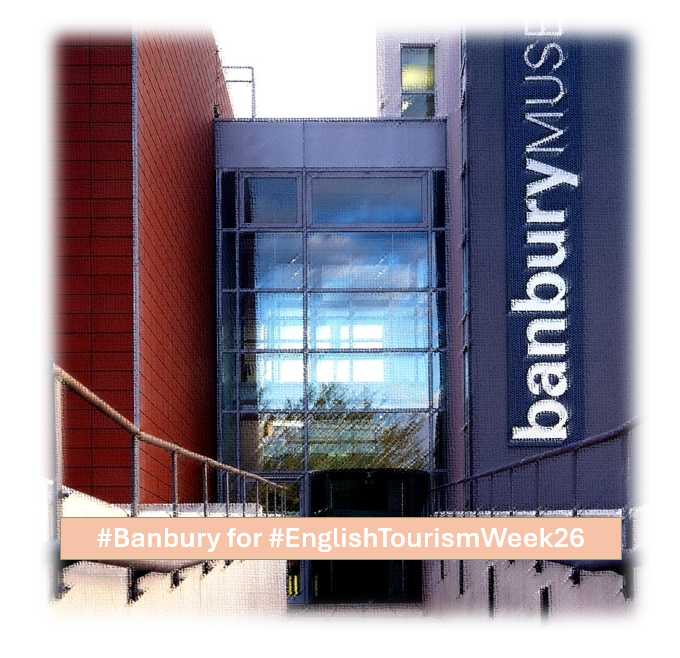
If you’ve walked along the canal from Spiceball Park, along The Light Banbury, past the GF Club And Waterside Bar Banbury – you’ve almost certainly seen it. The glass-fronted building sits right alongside the Oxford Canal and holds the story of Banbury and the surrounding area within it.

The museum’s permanent collections cover everything from the town’s Civil War connections and famous Banbury cakes to Victorian industry, canal trade and the everyday lives of the people who lived here over the centuries. It’s the sort of place where you can wander in for a quick look and suddenly realise you’ve spent far longer than planned.

And then there is the Pye Gallery – a space that hosts an impressive array of temporary and traveling exhibitions covering everything from Grayson Perry to Vikings, from 90s pop culture to robots and Lego, and even Wildlife Photographer of the Year.

Like many local museums across the country, Banbury Museum recently found itself at the centre of a debate about funding and priorities. When the possibility of losing support was raised, local residents made it very clear how much the museum matters to the town – and I must say I was pleasantly surprised to see how many people came out in support of the museum as quickly as they did.

Letters were written. Voices were raised. A great deal of hullabaloo ensued. And I wasn’t the only one surprised. In the end, the message landed: this is a cultural asset that the people of Banbury value, and the council found the money after all.

The museum remains open, continuing to tell the stories of the town and the people who shaped it.

So if you’re exploring Banbury during English Tourism Week, it’s well worth stepping inside.

Because behind that glass façade is not just a collection of objects — it’s the story of Banbury itself.

#Banbury #englishtourismweek2026

English Tourism Week 2026 in Banbury: Ride a What to Where?

Day 2 of my English Tourism Week 2026 in Banbury – and let’s start off today with a question.

If you asked to guess what Banbury is most famous for – and you weren’t allowed to say “being near Bicester Village” – what might you say?

Well, if you read yesterday’s post you might say Banbury cakes. But let’s pretend you didn’t read it and you suggest ….?

Yes! The nursery rhyme.  You know the one:

Ride a cock horse to Banbury Cross
To see a fine lady upon a white horse
With rings on her fingers and bells on her toes
She shall have music wherever she goes.

For many people, that rhyme is their very first (and only) introduction to Banbury. And they are often delighted to learn that there really is a Banbury Cross.

The one we see today in the town centre isn’t one of the original medieval crosses. There were three – the White Cross, the Bread Cross, and the main Market Cross. Those were removed by the Puritans around 1600-1602. I mean, what do you expect from people who would frown on pastry.

Anyway, you can see the marker where the original Market Cross stood in the marketplace near the entrance to Castle Quay.

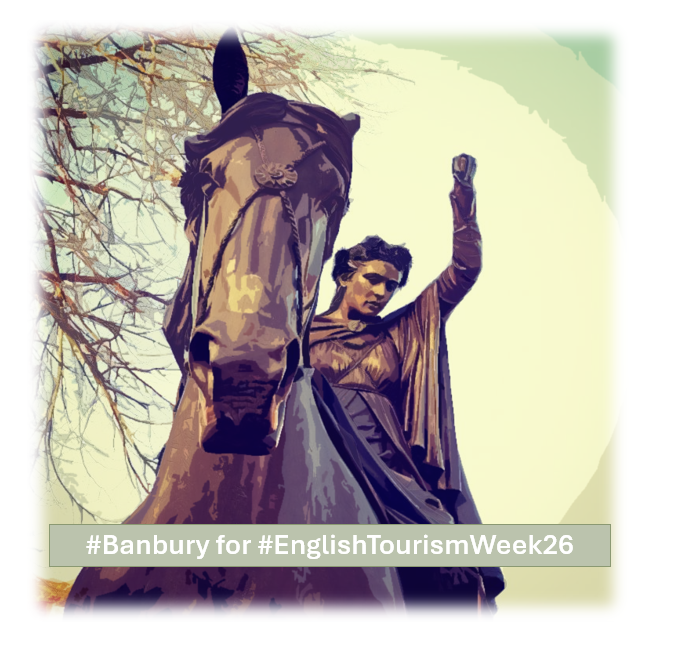
The current Banbury Cross, the one in the roundabout at the end of the High Street, was built in 1859 to celebrate the marriage of Queen Victoria’s daughter, Victoria, to Prince Frederick of Prussia. And it has its own fine lady, in the form of a statue across the way.

The statue is a much more recent addition, installed in 2005 and now one of the most photographed sights in town. Quite rightly too – it’s a striking statue and, thanks to its placement, full of excellent photographic angles and backgrounds.

But here’s another question and one that has been debated for generations:

Who exactly is the Fine Lady?

There are several theories.

  • Some believe she represents Queen Elizabeth I, who is known to have visited Banbury in the 1500s. Not sure I buy that.
  • Others suggest she might be Celia Fiennes. Sure there’s a vague local link but still not convinced.
  • And some historians think the rhyme may never have referred to a specific person at all. Probably the most likely.

Whatever the answer, the rhyme, the cross, and the Fine Lady have become part of Banbury’s identity.

So if you’re in town this week for English Tourism Week, take a moment to stop by Banbury Cross.

You’ll find the Fine Lady still riding proudly through the centre of town – rings on her fingers, bells on her toes, and a nursery rhyme that has been carrying Banbury’s name across the world for a very long time.

#Banbury #EnglishTourismWeek2026

Staycations: the joys of local exploring

Living in Banbury gives me so many fab opportunities for staycation days right on my doorstep. I have joked for years that the tagline for Banbury should be ‘Banbury, you can get there from here.’  And since we’re on a long weekend, it felt like a perfect time to share again why I think local days out and nearby adventures are a great way to recharge.

One thing to clarify before I wax lyrical about staycations. I don’t define a staycation as domestic tourism as seems to be more and more common these days. I define a staycation as not traveling to other accommodations, staying at home with day trips to local attractions. You define it however you like. But that’s what I mean when I use the phrase.

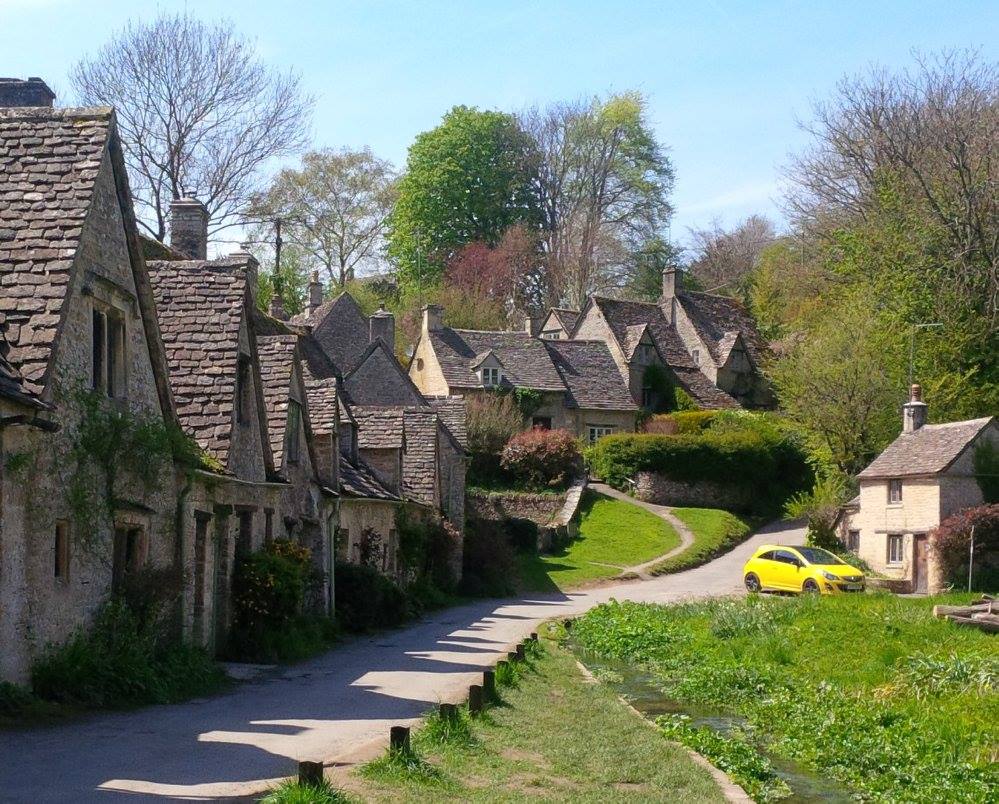
From Staycation 2016: Wordsworth may have called Bibury the prettiest village in England but he never saw that little yellow car. I rather like the sassiness of the little car. It drives the neighbors and tourists crazy but what’s owner supposed to do? It’s the only place the park.

6 Reasons to choose a staycation:

  • Time friendly and time efficient: staycations mean you don’t have to be at an airport 2-3 hours before your flight. You don’t spend time flying, getting to and from airports at both ends. You start your adventure faster and have more time to enjoy! As for when to take them – they fit in almost anywhere: long weekend, regular weekend, random day off? We’ve even done a week-long series of staycations. It was fantastic!
  • Less stressful: overall planning is less involved, bookings are often much less complicated, no airport queues, no cancelled flights or missed flights or late flights. No lost luggage. Heck, no packing (other than maybe a snack in the tote bag) and no post-trip laundry marathons.
  • Easier on the wallet: amazing how not having to pay for flights or accommodation can enhance a day’s fun. Also, staycations don’t require visas, travel insurance, or currency exchange. Will you spend money? Yes. But you’ll be spending money on the food, the fun and the finding out about stuff. Not on the paperwork and logistics.
  • Discovering hidden gems: I’ve enjoyed countless places that never make it to the top ten places to visit, never get mentioned on travels – but which are all talked about in local groups, found in brochures on display at local museums and on flyers around town.
  • Reducing environmental impact of travel: No one can change the impact of travel and tourism on the environment on their own. But everyone can do their part. I’m not saying you shouldn’t go on longer trips or further distance trips – but you don’t have to do it every time the travel bug bites.
  • Support local economies: I am a huge supporter of #ShopLocal and staycations are one way to help sustain local jobs, businesses, attractions, and communities. You can’t buy these experiences online.
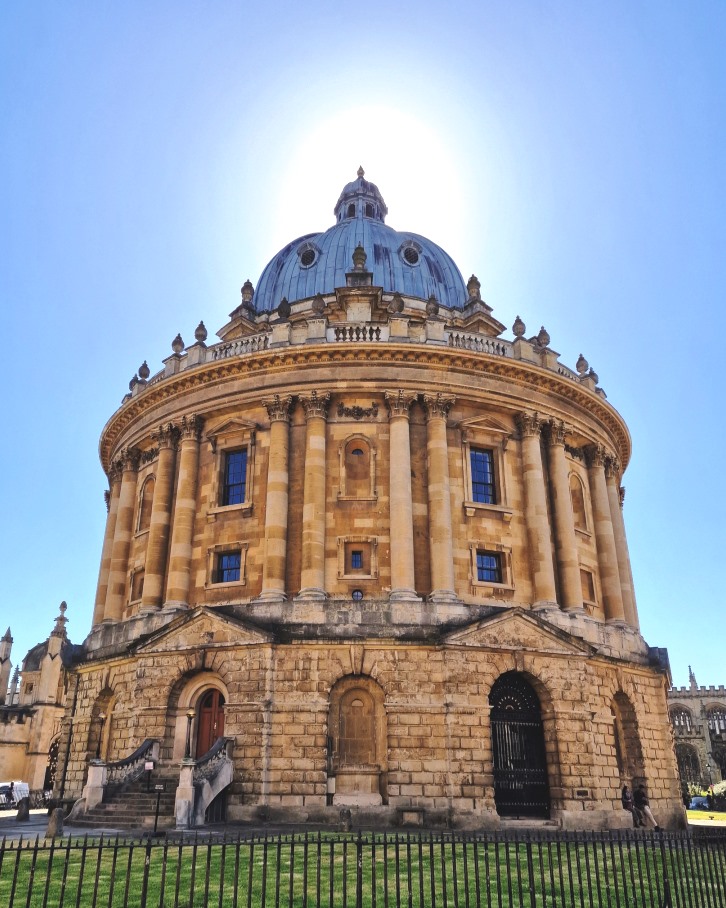
From staycation 2025: The Radcliffe Camera looking resplendent in the late afternoon light in Oxford.

5 staycation destinations near Banbury worth exploring:

  • Oxford: 20 minutes by train. What could be easier and quicker? The Bodleian tour alone is worth a day in Oxford to me. It was one of the first things I did on my first trip to Oxford and I cannot recommend it highly enough.
  • British Motor Museum: We’ve gone a few times and it never ceases to impress – even if you are not, strictly speaking, a petrol head.
  • Cotswold Wildlife Park: this may be one of the best wildlife parks I have ever visited and I have visited a LOT. It’s just outside Burford (a nearly picture postcard perfect village worth a visit on its own) and contains 160 acres of well thought out paths, enclosures and displays of wildlife from rhinos to red pandas. I will never, ever get enough of red pandas.
  • Hook Norton Brewery: never heard of it before moving to Banbury and I suspect most people traveling to the UK will never hear about it either. Whisky distilleries, yes. Wineries, sure. But not this. And that’s a shame because it is a true gem and if you can go there, you really ought to. Naturally, the tour includes not just seeing the brewing in action but samples as well.
  • Sulgrave Manor: We’re always told about national trust properties (plenty of those around Banbury – Upton House, just one fine example) and we hear about Blenheim (everyone loves a palace) and we have a local castle (Broughton, which will be familiar to anyone who watched Wolf Hall). But rarely does Sulgrave get mentioned except locally. As an American, I was very amused to hear that George Washington’s ancestral home was basically 15 minutes away.

* * * * * * * * * * * *

What are your favorite local day trips? Maybe you’ll help someone near you find hidden gems near them!